Event
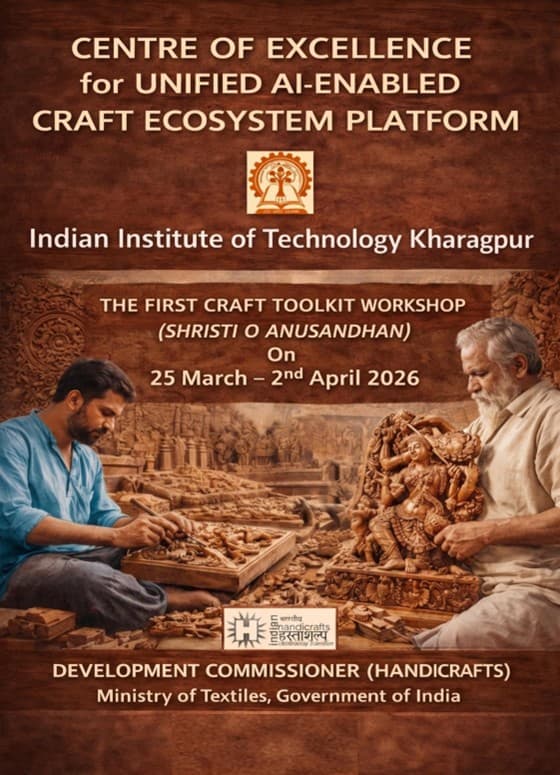
The First Craft Toolkit Workshop on Wood Carving Traditions of India
When
Session times are on the agenda below, and are given in India Standard Time (GMT+5:30).
This event has finished
Downloads a small .ics file holding this one event, which Apple Calendar, Outlook, Google Calendar and Thunderbird all open. It records the exact instants rather than the wording above, so your own calendar will redraw the event on your clock — the times on this page are India Standard Time (GMT+5:30), the Centre's own. Because the record covers more than one day it is entered as an all-day span rather than a timed block, with the times written into the entry's notes. This event has already finished, so the entry lands in the past — useful as a record, not as a reminder.
About this event
The First Craft Toolkit Workshop on Wood Carving Traditions of India was organised from 25 March to 2 April 2026 at IIT Kharagpur. The workshop was conducted by the Centre of Excellence for Unified AI-Enabled Craft Ecosystem Platform and sponsored by the Office of the Development Commissioner (Handicrafts), Ministry of Textiles, Government of India.
As the inaugural workshop of the initiative, it established a collaborative platform for documenting, studying, and preserving India’s traditional woodcraft knowledge. It brought together artisans, experts, researchers, students, and visitors.
The workshop included artisans representing six traditional wood-based crafts from different parts of India. These were Khatamband from Jammu and Kashmir, Kallakurichi wood carving from Tamil Nadu, Udayagiri wooden cutlery from Andhra Pradesh, Delhi wood carving, Odisha wood carving, and Tripura bamboo-root carving.
The participating traditions represented architectural woodcraft, sculptural carving, utility-based wooden products, and bamboo-root carving. This diversity helped the research team understand the regional variations in materials, tools, designs, processes, and cultural meanings associated with Indian woodcraft.
The main objective was to systematically document traditional tools, raw materials, production methods, artisan skills, and indigenous knowledge. The workshop also examined the functional, technical, cultural, and ergonomic aspects of traditional woodworking toolkits.
During the morning sessions, experts and researchers interacted individually with the artisans. These discussions covered craft histories, inherited knowledge, wood selection, tools, production techniques, working difficulties, and possibilities for future development.
The artisans demonstrated their production processes through live sessions. Their knowledge was documented using structured interviews, photographs, videos, audio recordings, field observations, and detailed process notes.
The process documentation began with the selection of suitable wood. Artisans explained how grain, hardness, durability, workability, seasoning, and local availability influence the selection of wood for different products and carving styles.
Material preparation processes such as seasoning, cutting, sizing, surface preparation, marking, and design transfer were also documented. These stages are important for maintaining dimensional stability and preventing the wood from cracking or warping.
The carving demonstrations covered rough shaping, relief carving, piercing, sculptural detailing, engraving, motif development, and fine finishing. The use of chisels, gouges, mallets, knives, and other specialised tools was recorded at different stages of production.
The workshop also documented surface-finishing methods such as sanding, smoothing, polishing, staining, oiling, painting, lacquering, waxing, and applying protective coatings. These methods improve the appearance, durability, and usability of the finished products.
Artisans acted as the main knowledge contributors throughout the workshop. They explained the cultural importance of their motifs, demonstrated inherited skills, and shared practical knowledge acquired through generations of observation and experience.
Experts and researchers examined the crafts from technical, design, ergonomic, and innovation-related perspectives. Their interaction with the artisans helped identify possibilities for improving tools, products, working comfort, and production processes while retaining the traditional identity of each craft.
A craft exhibition was organised during the final three evenings of the workshop. Visitors interacted directly with the artisans, observed live demonstrations, and learned about the technical skill and cultural knowledge involved in transforming raw wood into finished products.
One of the workshop’s major achievements was the development of a standardised framework for documenting craft toolkits and production processes. This framework will support the consistent documentation and comparison of other craft traditions in future workshops.
The workshop produced detailed records of artisan profiles, tools, materials, techniques, production stages, expert observations, photographs, videos, and audio interviews. These materials created an important foundation for a structured digital craft-knowledge repository.
Overall, the workshop demonstrated that wood carving is not simply a method of making decorative or functional objects. It is a living knowledge system combining material understanding, technical ability, cultural memory, artistic expression, and intergenerational learning.
The information collected during the workshop will support future research, digital preservation, craft education, toolkit development, GIS-based craft mapping, product innovation, and greater public awareness of India’s diverse wood-carving heritage.