Event
Bamboo & Cane Craft and Hand Block Printing-Sristi O Anusandhan
When
Session times are on the agenda below, and are given in India Standard Time (GMT+5:30).
This event has finished
Downloads a small .ics file holding this one event, which Apple Calendar, Outlook, Google Calendar and Thunderbird all open. It records the exact instants rather than the wording above, so your own calendar will redraw the event on your clock — the times on this page are India Standard Time (GMT+5:30), the Centre's own. Because the record covers more than one day it is entered as an all-day span rather than a timed block, with the times written into the entry's notes. This event has already finished, so the entry lands in the past — useful as a record, not as a reminder.
About this event
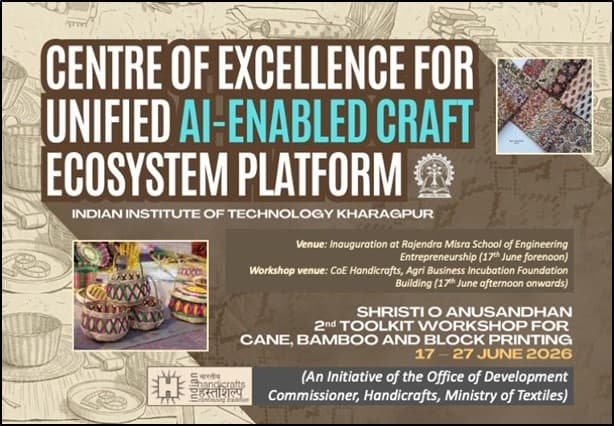
The Second Craft Toolkit Workshop on Bamboo and Cane Craft and Hand Block Printing was organised from 17 to 27 June 2026 at the SHRISTI and ANUSANDHAN centres of IIT Kharagpur. It was conducted under the Centre of Excellence for Unified AI-Enabled Art and Craft Ecosystem Platform in collaboration with the Office of the Development Commissioner (Handicrafts), Ministry of Textiles, Government of India.
The workshop brought together 16 artisans from Rajasthan, Gujarat, Andhra Pradesh, Uttar Pradesh, Uttarakhand, and Jammu and Kashmir. They represented several traditions, including Bagru printing, Sanganeri printing, Dabu printing, Kalamkari, Ajrakh, cane craft, bamboo craft, and Ringal craft.
The main purpose of the workshop was to document traditional craft knowledge directly from artisans. Particular attention was given to their tools, raw materials, production processes, inherited skills, cultural practices, and everyday challenges.
During the morning sessions, designers and researchers interacted individually with the artisans. These discussions helped the team understand each artisan’s background, working methods, material knowledge, tool requirements, and possibilities for product improvement.
The artisans also demonstrated their craft processes. Photographs, videos, audio recordings, interviews, and field notes were collected to document the different stages of production and the practical knowledge involved in each craft.
In hand block printing, the workshop documented fabric preparation, dye preparation, block printing, drying, washing, colour fixing, and finishing. The artisans demonstrated how precision, pressure, colour distribution, and block alignment influence the quality of the printed fabric.
For bamboo and cane crafts, the documentation covered material selection, cutting, cleaning, splitting, sizing, treatment, weaving, shaping, assembly, polishing, and finishing. The discussions highlighted how artisans use experience-based knowledge to select appropriate materials and produce strong, functional, and attractive objects.
The afternoon sessions encouraged collective interaction among artisans, designers, experts, researchers, and project members. These discussions explored design development, improved tools, sustainability, innovation, market opportunities, and the future development of traditional crafts.
A public exhibition was organised during the final three evenings of the workshop. Artisans displayed their products and conducted live demonstrations, allowing campus residents and outside visitors to interact with them and understand the technical and cultural value of handmade products.
One of the workshop’s major achievements was the development and use of the Field Repository App. The app made it possible to systematically collect, categorise, and store artisan profiles, interviews, photographs, process videos, audio recordings, tools, materials, products, and field observations.
The workshop resulted in a detailed craft toolkit report and a structured digital collection of craft-related information. It also strengthened knowledge exchange among artisans, designers, researchers, experts, and members of the public.
Overall, the workshop demonstrated that traditional crafts are not merely finished products. They represent interconnected systems of technical skill, cultural memory, material knowledge, ecological understanding, and community practice. The collected information will support future research, craft preservation, innovation, education, and the sustainable development of artisan communities.